Hard and colour, formal and informal, serious and light-hearted - news and opinion
Sunday, July 7, 2013
Review: Hot Shoe Shuffle, 21st Anniversary revival Sydney
Hot Shoe Shuffle
5 July 2013
Lyric Theatre, Sydney
Happy 21st Anniversary to David Atkins and Dein Perry, creators of Hot Shoe Shuffle; one of Australia's most successful home-grown musicals.
There's no better place or time to revive the show. There's also no better place or time to revise the book.
The tap numbers are thrilling and impressive, just as you'd expect of co-choreographers Perry (who also created the international tap hit, Tap Dogs) and Atkins (a prominent figure in the musical industry who wears many creative hats).
But the cringe-worthy script needs a re-write. The thin, cheesy plot about seven brothers re-united through a phony ploy from their absent father to put on a tap show makes for a flimsy foundation to build a show upon. Worse still, the script is naff and cartoon-like, resulting in a cast of two-dimensional, unsympathetic characters and jokes that fall flat.
Musical numbers are hit and miss, and mostly provide good excuses for entertaining tap dances. That said, both of Jaz Flower's stand and sing numbers in the second act are knock-out. Flowers has an electric stage presence and plays an impressive Marilyn-inspired sensual bombshell.
The two acts couldn't be more different. The first presents an artificial, larger-than-life world filled with colourful costumes and a cardboard-cut-out set reminiscent of Hairspray. The second is classy, ritzy and a homage to the best of old-school Vaudeville - with top hats, coat tails and the gorgeous orchestra in full-view. The second act is better than the first, mostly because the characters talk less and dance more, but also because the set and costume design better complement the style of the show.
As an entire musical, the highs are high - such as the talented Bobby Fox's tap solo which merits its own standing ovation. But the lows are low - thanks to a poor script that isn't helped by over-the-top, superficial, bad acting performances by the cast.
Hot Shoe Shuffle displays many of the strengths and weaknesses of the Australian musical theatre industry: fantastic dance talent yet poor acting performances, crafted moments of incredible spectacle that sit alongside uninspired scenes that fall flat, and an abundance of energy for a show that still need fine-tuning.
Australian audiences should see Hot Shoe Shuffle for the fantastic, highly-skilled tap numbers that showcase our home-grown choreography and dance talent. They will just have to forgive some of the silliness.
$20 student tickets available on the day of performance at the Lyric Theatre.
For tickets, visit http://www.hotshoeshuffle.com/tickets-sydney
Showing in Sydney 5 July - 4 August, Melbourne 9 August - 1 September
Labels:
21st Anniversary,
Australia,
Bobby Fox,
dance,
David Atkins,
Dein Perry,
Hot Shoe Shuffle,
Jaz Flowers,
Lyric Theatre,
musical,
review,
sydney,
tap,
tap dancing,
theatre,
what's on
Tuesday, November 20, 2012
Review: First preview of new Mamet play The Anarchist on Broadway, with Patti LuPone
The Anarchist
First preview, 13 November 2012
Golden Theatre, New York
First preview, 13 November 2012
Golden Theatre, New York
There
is a lot of buzz surrounding The
Anarchist. Famed Broadway playwright David Mamet not only directs but he directs Patti LuPone, with whom he has a colourful 30-year past.
Despite the hype, there are no fireworks – neither good nor bad – in
this production. Mindful that this is only the first preview, there are
significant kinks for the team to iron out before opening.
The
play deals with heavy yet pertinent philosophical debates. Serving a life
sentence in prison, Cathy (LuPone) makes a final plea to unsympathetic warden Ann (Debra Winger) for why she is sufficiently rehabilitated, in what becomes
an intellectual battle about the necessity of the state over anarchy. Mamet’s
work offers an enlightening engagement with the complex topics that come with such territory, like
justice, faith, control and kindness.
Despite
the compelling subject matter, the production fails to fully
articulate its substance. It takes a long time to warm up, which is in
large part due to the wordiness and awkward formality of the script. Both
traits are textbook Mamet, but dozens of audience members didn’t settle into the
play and left before curtain – which was particularly concerning considering
the show only ran for 70 minutes without interval.
There is a stagnant nature
to Winger and LuPone's performances. Both are robotic in their
delivery (Winger more so than LuPone) to the point that it looks like a line run. The lack of variation in tonality and flow could be a sign of more time needed to settle into their characters, but is
also likely a reflection of Mamet's deliberate creation of two clinical, almost
emotionless characters.
As it
currently stands, the pair generate a strange energy; Winger as the warden is
calm and bland to LuPone’s fidgety but somewhat sedated portrayal of prisoner,
Cathy. They are chalk and cheese, only without the spark that you would expect
from such antipodean characters. Drama stems from the language, not the
performance (and certainly not the banal set and lighting design). While this
may work stylistically, it makes for an unremarkable physical performance.
The
Anarchist didn't thrill but it did stimulate. LuPone and Winger's
performances were there but underdone, and it will be interesting to see the show
post-previews when both have had time to roost. The play itself
is intriguing and makes for an odd but interesting contribution to
the current Broadway season.
Labels:
Broadway,
David Mamet,
Debra Winger,
Golden Theatre,
New York,
Patti LuPone,
preview,
review,
The Anarchist
Friday, November 16, 2012
Review - Broadway - Scandalous: The Life and Trials of Aimee Semple McPherson
Scandalous for all the wrong reasons
Sunday 11th November, 2012
Neil Simon Theatre, New York
Book and lyrics: Kathie Lee Gifford
Music: David Pomeranz and David Friedman
Director: David Armstrong
Choreography: Lorin Latarro
Neil Simon Theatre, New York
Book and lyrics: Kathie Lee Gifford
Music: David Pomeranz and David Friedman
Director: David Armstrong
Choreography: Lorin Latarro
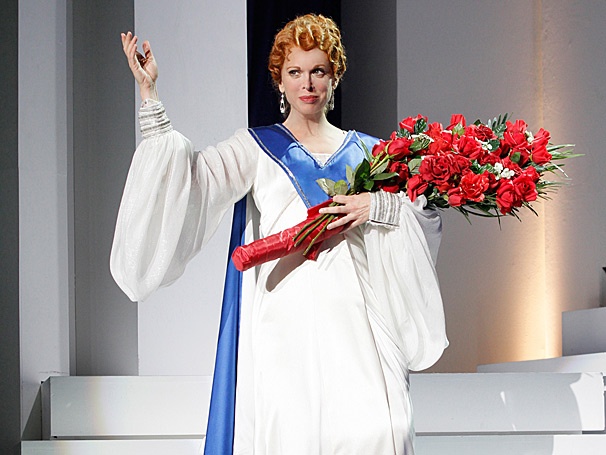
Carolee Carmello’s spirited performance as Aimee Semple McPherson in Scandalous is the only saving grace in what is otherwise a lackluster new musical.
Scandalous documents the life of early 20th Century evangelist Semple from her childhood to her mysterious kidnapping and ensuing public trial. Despite such promising subject matter, heaven couldn’t help this show, which spends too long preaching religious doctrines rather than examining the juicy details of the evangelist's controversial life. Villain or victim? Sinner or saint? The substance of the moral debate comes too little too late.
The religiosity of the show will distance many atheists and
non-Christians. Bible bashing comes with the territory – a story about a
preacher has to have preaching in it – but there is no creativity or
imagination in the book or score. The show sounds like Oklahoma meets Wicked,
with nothing original to offer. One of the big belty numbers “Why Can’t I” is more-or-less a regurgitation of “The Wizard and I.”
The score’s only strength is that it gives Carmello a chance
to show off her impressive vocals. Aimee Semple is a physically and vocally
demanding role. Carmello leaves the stage so infrequently that cast members
have to bring her a glass of water during transition scenes.
Staging (design by Walt Spanger) is one of the stronger points of the show,
especially Semple’s versatile Angelus Temple set that transforms into ballrooms and
houses. The show also churns through a great number of costumes (design by
Gregory Poplyk); some for scenes that only last a few minutes. Particularly, a lot of effort
is put into re-creating the elaborate Biblical sets Semple uses for her weekly
sermons. From Adam and Eve to Moses and Samson and Delilah, the scenes are a
visual spectacle, yet such colossal changes for so little stage time don’t add
enough value to warrant the effort. If anything, they seem a shameless attempt
to draw attention away from the boring book and score and add some life to the
performance.
Funny moments with the stereotypical comedic black sidekick
(played by a fierce Roz Ryan) make for the rare light touches in the story. Edward Watts as Semple’s first and (thanks to a wig change) third husband gives a solid performance.
George Hearn as Semple’s father and later rival preacher, however, is a surprising
disappointment. Hearn is so comfortable on stage that it felt like we were in
his living room watching him perform. He lacked vocal projection and stage
presence. Carmello as Semple, on the other hand, is stupendous. Her Semple is
so lovable and warm that it’s hard to think ill of her even as she runs away
with a married man.
A story about a woman surrounded by strong woman is fresh
air in a male-dominated musical industry. Beyond gender politics, though, the
strength of the story – and what gives the subject matter potential (even if it
is unfulfilled in this production) – is the musical’s discourse about morality
and justice. Here is a preacher who cares for people and gives their lives’
meaning but is a hypocrite by her own terms. Does such hypocrisy rule out all
good? Justice is perverted and a guilty woman gets off free, but Semple couldn’t
continue to help society’s needy from a jail cell. The show demonstrates that,
ironically, there are no black and white truths; that what is right is not
always clear-cut – despite the fervent doctrines Semple preached. This
discussion, along with Carmello’s giving performance, are the only incentives
to see Scandalous.
For tickets, visit: http://scandalousonbroadway.com/
Tuesday, November 13, 2012
Review: Peter and the Starcatcher on Broadway
Peter and the Starcatcher
Sunday, 11 November 2012
Brooks Atkinson Theatre, New York
Peter and the Starcatcher is to Peter Pan what Wicked is to The Wizard of Oz; it offers a compelling and imaginative precursor to a literary and theatrical classic. Better still, it stands its own against its older and more popular sibling.
When an orphan boy and his mates find themselves on board the S.S. Neverland, they cross paths with the crooked pirate Black Stache and a boisterous 14-year-old Molly on a secret mission with her father from Queen Victoria. Through a series of cargo mix-ups, pirate plunders, and island wash-ups, Peter transforms into the Pan we know him to be.
Peter and the Starcatcher (adapted for the stage by Rick Elice - who recently brought us The Addams Family) is clever, witty and very funny. Scenes flow seamlessly under Roger Rees and Alex Timber’s direction, and the pliability and ingeniousness of the set (design by Donyale Werle) makes for an exciting adventure. Slapstick, witty and camp humour caters to all ages, and jokes hit their mark more often than not. The ensemble cast deliver solid, energetic performances, with Matthew Saldivar's Black Stache a stand-out.
There are few flaws in this show, which runs like a tight ship, but some jokes are too bizarre to land firmly, and the chummy boat songs scattered throughout the show seem out-of-place (and, for a second, had me thinking it was a book-heavy musical).
Peter and the Starcatcher is a show for the entire family, and a production I foresee having a long life performed everywhere from school halls to regional theatres and mainstage venues.
For tickets, visit: www.peterandthestarcatcher.com
Labels:
Broadway,
Matthew Saldivar,
Peter and the Starcatcher,
Peter Pan,
play,
review,
Rick Elice
Saturday, October 27, 2012
An open letter to the 2013 Walkley Review Committee in advocacy of Arts journalism
I publicly post my submission to the 2013 Walkley review committee in the hope that others who agree with my sentiments will be inspired to compose their own submission. This is an important issue for supporters of the Arts in Australia. Let's have the value of Arts journalism reflected in our national journalism awards body.
To the 2013 Walkley review board,
I was a journalist at news.com.au for two years and now intern as a publicist for the Casula Powerhouse Arts Centre in Sydney's south-west. I'm also a final year BA (media and communications) student at the University of Sydney.
My niche interest area is Arts journalism. At news.com.au, I covered events like the Helpmann Awards and wrote lengthy features about exciting movements within the industry (such as Australia as an upcoming destination for pre-Broadway and West End shows).
There are other arts journalists, like Elissa Blake, Karl Quinn, and Matthew Westwood, who unfailingly support the Arts through comprehensive and engaging journalism.
Without Arts journalism, the creative industries of Australia have a small voice and few platforms in which to voice their concerns and advertise their products. If certain companies do have a voice, it is because they are investing millions in marketing; a luxury some cannot afford. The trailblazers of our generation need audiences and exposure to have their effect on society; to challenge, enlighten, and entertain in innovative ways.
Arts journalism also fosters a community of art/theatre/dance/music-loving audiences. This community thrives on a sense of belonging and inclusiveness that is the fabric of a vibrant country. Broadway is Broadway because of the people and their supportive networks, not because of the rocks and mortar holding the place together. Arts journalism is a necessary supportive network for these artists and their audiences.
The Arts is necessary for society in the same way that we need clean air and green spaces. The Arts give people a way to express themselves; to communicate their greatest triumphs and most bitter downfalls with others who can relate to and learn from their humanity. There are also proven health, educational, economic and political benefits.
The list goes on, but, hopefully the value of the Arts and Arts journalism is becoming clear.
In light of this, then, it is saddening that there is no appreciation of the value of Arts journalism in the Walkley Awards. There are categories for business, international, investigative, Indigenous, sports, social equity, and opinion journalism. There are even awards for the best headline. But, no award for Arts journalism. Awards for travel and technology journalism are also absent, but, at least these niches have their own awards (The Lizzies for technology and ASTW for travel).
In 2013, it would be thrilling to see an award category for Arts journalism in the "All media" section. Hopefully this submission has played some part in justifying the need and value for such an award.
The Walkleys are a respected and widely-acknowledged system of praising good journalism. Let's make it a more inclusive national awards body by including an award for Arts journalism.
Kind regards,
Maryann Wright
Those who wish to make a submission to the Walkley Review Committee can do so here: http://www.walkleys.com/award-review-submissions. Submissions close on Friday December 7, 2012.
To the 2013 Walkley review board,
I was a journalist at news.com.au for two years and now intern as a publicist for the Casula Powerhouse Arts Centre in Sydney's south-west. I'm also a final year BA (media and communications) student at the University of Sydney.
My niche interest area is Arts journalism. At news.com.au, I covered events like the Helpmann Awards and wrote lengthy features about exciting movements within the industry (such as Australia as an upcoming destination for pre-Broadway and West End shows).
There are other arts journalists, like Elissa Blake, Karl Quinn, and Matthew Westwood, who unfailingly support the Arts through comprehensive and engaging journalism.
Without Arts journalism, the creative industries of Australia have a small voice and few platforms in which to voice their concerns and advertise their products. If certain companies do have a voice, it is because they are investing millions in marketing; a luxury some cannot afford. The trailblazers of our generation need audiences and exposure to have their effect on society; to challenge, enlighten, and entertain in innovative ways.
Arts journalism also fosters a community of art/theatre/dance/music-loving audiences. This community thrives on a sense of belonging and inclusiveness that is the fabric of a vibrant country. Broadway is Broadway because of the people and their supportive networks, not because of the rocks and mortar holding the place together. Arts journalism is a necessary supportive network for these artists and their audiences.
The Arts is necessary for society in the same way that we need clean air and green spaces. The Arts give people a way to express themselves; to communicate their greatest triumphs and most bitter downfalls with others who can relate to and learn from their humanity. There are also proven health, educational, economic and political benefits.
The list goes on, but, hopefully the value of the Arts and Arts journalism is becoming clear.
In light of this, then, it is saddening that there is no appreciation of the value of Arts journalism in the Walkley Awards. There are categories for business, international, investigative, Indigenous, sports, social equity, and opinion journalism. There are even awards for the best headline. But, no award for Arts journalism. Awards for travel and technology journalism are also absent, but, at least these niches have their own awards (The Lizzies for technology and ASTW for travel).
In 2013, it would be thrilling to see an award category for Arts journalism in the "All media" section. Hopefully this submission has played some part in justifying the need and value for such an award.
The Walkleys are a respected and widely-acknowledged system of praising good journalism. Let's make it a more inclusive national awards body by including an award for Arts journalism.
Kind regards,
Maryann Wright
Those who wish to make a submission to the Walkley Review Committee can do so here: http://www.walkleys.com/award-review-submissions. Submissions close on Friday December 7, 2012.
Saturday, September 15, 2012
Review: Bare Witness - reversing the gaze of war photojournalism
Casula Powerhouse Arts Centre (14 September 2012) presents a
La Mama Theatre/Fortyfive downstairs's touring production.
Bare Witness confronts, distresses and challenges perceptions of war journalists. We have all – to various degrees – seen the war in Iraq, the Balkans, and East Timor play out on our screens, radios and newspapers. But how often do we stop to think about the people providing such harrowing images, soundbites and quotes?
A short byline is all we get, and an edited snapshot of what a journalist sees. But, is the photo staged? Did the photographer manipulate the position of that lifeless body for dramatic effect? How did interviewing a mother grieving over her son’s lifeless body affect the journalist? Do they have nightmares?
Bare Witness presents fictional yet plausible snippets of war journalists’ life. From the infrequent calls home to see how mother is doing to the fear of hiding in enemy territory while a shower of gunfire opens up outside, the play takes the audience on an at times literal and at other times abstract journey through the motions of war.
Some scenes (directed by Nadja Kostich) come across as too abstract to the point that meaning is lost, but, on the whole, contemporary movement combined with prose is an effective mode of storytelling. The Casula Powerhouse is a larger and more conventional theatre than the original staging in Melbourne’s 45 Downstairs, but the creative team make a good effort to preserve the rough and gritty nature of the play in its new venue.
With a strong cast (particularly Daniela Farinacci as Dannie) – albeit with some questionable accents – and a strong concept, Australian playwright Mari Lourey’s work makes for a valuable night at the theatre. Valuable because Bare Witness fulfills one of the most important roles of theatre: to make an audience think by taking them out of their comfort zone and challenging the way they understand and make meaning of the world.
Bare Witness asks the important question: who bears witness to those journalists who bear witness to the victims of war? Journalists risk everything to tell the horrific stories of the disempowered who are used as political pawns by their governments, but who is telling the journalist’s stories?
As the show's symbolism suggests - like wolves, journalists hunt in a pack searching for meaty news pieces to send home to their hungry audiences. Yet, if the pack prowl too close to enemy territory where the juiciest cuts are, they become the hunted. It’s our job as an audience to track those movements and bear witness to their successes, failures and sacrifices.
Bare Witness runs at the Casula Powerhouse Arts Centre from 14-15th September.
Bare Witness confronts, distresses and challenges perceptions of war journalists. We have all – to various degrees – seen the war in Iraq, the Balkans, and East Timor play out on our screens, radios and newspapers. But how often do we stop to think about the people providing such harrowing images, soundbites and quotes?
A short byline is all we get, and an edited snapshot of what a journalist sees. But, is the photo staged? Did the photographer manipulate the position of that lifeless body for dramatic effect? How did interviewing a mother grieving over her son’s lifeless body affect the journalist? Do they have nightmares?
Bare Witness presents fictional yet plausible snippets of war journalists’ life. From the infrequent calls home to see how mother is doing to the fear of hiding in enemy territory while a shower of gunfire opens up outside, the play takes the audience on an at times literal and at other times abstract journey through the motions of war.
Some scenes (directed by Nadja Kostich) come across as too abstract to the point that meaning is lost, but, on the whole, contemporary movement combined with prose is an effective mode of storytelling. The Casula Powerhouse is a larger and more conventional theatre than the original staging in Melbourne’s 45 Downstairs, but the creative team make a good effort to preserve the rough and gritty nature of the play in its new venue.
With a strong cast (particularly Daniela Farinacci as Dannie) – albeit with some questionable accents – and a strong concept, Australian playwright Mari Lourey’s work makes for a valuable night at the theatre. Valuable because Bare Witness fulfills one of the most important roles of theatre: to make an audience think by taking them out of their comfort zone and challenging the way they understand and make meaning of the world.
Bare Witness asks the important question: who bears witness to those journalists who bear witness to the victims of war? Journalists risk everything to tell the horrific stories of the disempowered who are used as political pawns by their governments, but who is telling the journalist’s stories?
As the show's symbolism suggests - like wolves, journalists hunt in a pack searching for meaty news pieces to send home to their hungry audiences. Yet, if the pack prowl too close to enemy territory where the juiciest cuts are, they become the hunted. It’s our job as an audience to track those movements and bear witness to their successes, failures and sacrifices.
Bare Witness runs at the Casula Powerhouse Arts Centre from 14-15th September.
Monday, September 10, 2012
Why 'I Will Survive' should survive
I Will Survive is getting a hammering from critics. Some reasons are valid but I also get a sense that there's a stifling of any real desire for originality within the talent show-slash-reality genre.
Daniel Burt for one is more than happy to bang on about the “confused” concept and the fall-through with the prize to perform on Broadway. Sure, men in drag doesn’t equate to a triple threat ready for the bright lights of Broadway and, sure, the boys won’t get to play Tick in Priscilla. I’ll also grant that the show’s structure focuses a little too much on un-related whimsy (like playing footy and going to firing ranges) and not enough on showing off the contestant’s talents.
But, what the show does offer is an acknowledgment of the musical theatre audience in Australia, and I think that is long overdue. Triple threat isn’t a word used much on talent shows. Sometimes “talent” doesn’t even come into play; a good sob story is worth its weight in airtime over someone who can hold a note for longer than two seconds. Shows search for the “x factor” and wind up with another Justin Bieber or Katy Perry. Musical theatre is different. It is home to triple threats who don’t want to be on the next cover of NW Magazine but want to slog their guts out singing, dancing and acting live on stage eight shows a week.
Talent shows in Australia are scattered with musical theatre
performers. The likes of Jaz Flowers and Matt Heatherington from the first
season of The Voice spring to mind.
Yet if either had sung a song from a musical using their trained musical
theatre technique, they would have been crucified. The musical-theatre-loving
audience is almost completely ignored on commercial television. Why? God knows.
So I for one am happy to think that Kyle Sandilands would
have his head in a bucket being sick at all the “musical theatre cheesiness”. I Will Survive celebrates diversity. It
talks about and brings value to the idea of a triple threat, it showcases some
talented Aussie blokes who otherwise never get their spot of commercial
television, and it celebrates Australia’s best-known musical export – Priscilla.
Does the exact format of I
Will Survive work? No. It is confused and does focus more on the fun of
drag rather than the skills needed to be on Broadway. Is it a fun show to
watch? Yes. There are loads of laugh-out-loud moments and the contestants are
an interesting bunch.
I would love to see a talent show like BBC’s Any Dream Will Do! and How Do You Solve a Problem Like Maria?
that casts the next lead in a musical. That format would give a real
perspective of the musical theatre industry. But, for now, I will certainly
settle for I Will Survive, and
applaud Channel Ten for giving this show a chance.
So to all the haters: get off the soapbox. If you want to
play the ratings card, take a glimpse at what is rating higher than I Will Survive and have a quick think
about how that show is contributing to greater diversity on Australian
television. Do you really want to watch another reality show filled with models
pretending to be “wife-material” or “geek-trainers” to get a leg up in their next audition?
I Will
Survive is catering (albeit strangely) to a neglected
theatre-loving audience. Let's support this strange child that is trying to do
something different for once.
I Will Survive airs Tuesday and Wednesday nights at 7:30pm on Channel Ten.
Subscribe to:
Posts (Atom)